Solution Brief
SafeBreach Exposure Validation Platform
Read More
On December 4, 2025, the U.S. Cybersecurity and Infrastructure Security Agency (CISA), National Security Agency (NSA), and the Canadian Centre for Cyber Security jointly released Malware Analysis Report AR25-338A analyzing BrickStorm malware, a sophisticated backdoor attributed to the People’s Republic of China (PRC) state-sponsored cyber actors. The report outlines how attackers leveraged BrickStorm in VMware vSphere and Windows environments to achieve long-term persistence, perform credential theft, exfiltrate data, and conduct stealthy command-and-control operations.
BrickStorm is designed for durability and stealth. It blends its traffic with legitimate HTTPS/WebSocket activity, uses DNS-over-HTTPS for C2 discovery, and employs multiple persistence mechanisms—including modifying VMware init scripts and self-watching process logic. It also includes SOCKS proxy functionality for lateral movement and full file-system manipulation.
The SafeBreach Labs team responded quickly to this alert, evaluating existing coverage and providing new coverage to help organizations quickly validate their exposure in light of this significant threat. The SafeBreach Exposure Validation Platform includes simulations aligned to BrickStorm’s TTPs across initial access, persistence, privilege escalation, command and control, and exfiltration.
In the blog below, we will share an overview of the threat, highlight key techniques used, and identify new and existing attack content relevant to BrickStorm malware that is now available within the SafeBreach Exposure Validation Platform.
Check out our recently released podcast episode, where host Tova Dvorin is joined by SafeBreach expert Adrian Culley to break down CISA’s Alert AA24-109A. Listen now on Spotify or Apple Podcasts.
According to CISA’s analysis of eight malware samples, BrickStorm:
Notably, CISA observed nation-state actors leveraging BrickStorm to steal VM snapshots for credential extraction and to create hidden rogue VMs—activities aligned with long-term espionage and operational persistence.
As soon as details were made available, the SafeBreach Labs teams added new attacks based on the analysis report and mapped existing attacks in the Hacker’s Playbook based on that. It is important to note that existing SafeBreach customers already have some coverage against the BrickStorm malware identified in this alert. Please run/re-run the attacks listed below to ensure your environment is protected against these TTPs.
As new indicators, signatures, or variants emerge, SafeBreach continuously updates our Hacker’s Playbook to maintain complete coverage for the BrickStorm campaign.
Based on CISA, NSA, and Cyber Centre guidance, organizations should:
SafeBreach customers can simulate these threat techniques on-demand to confirm whether their controls detect and block the specific TTPs outlined in AR25-338A.
From the SafeBreach homepage, select Explore Scenarios in the CISA Alert AR25-338A New Coverage pop-up.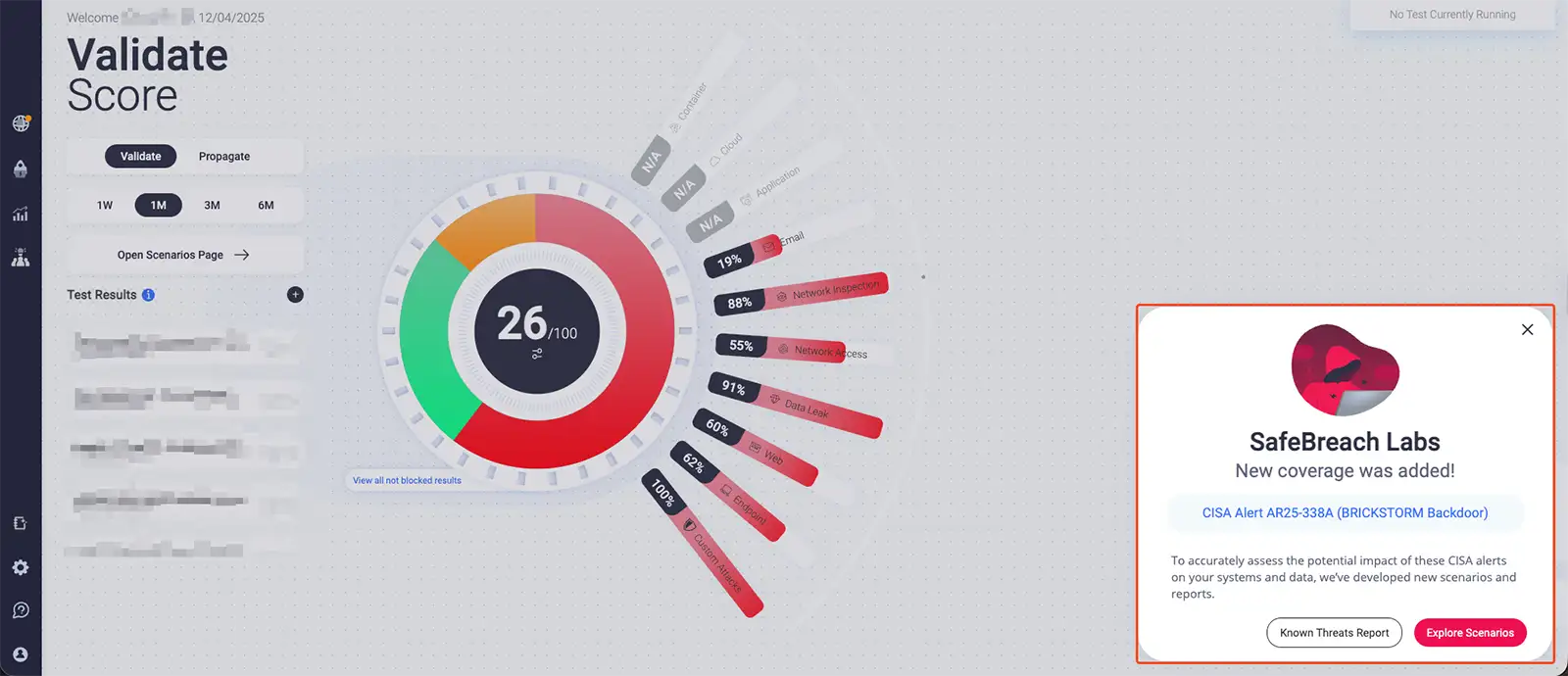
Navigate to the “SafeBreach Scenarios” page and select the CISA Alert AR25-338A scenario.
From the Known Threats Series report, select CISA Alert AR25-338A and select Run Simulations, which will run all attack methods.
BrickStorm underscores the sophistication of modern cyber-espionage operations, particularly those targeting virtualization layers that often lack robust monitoring.
SafeBreach’s platform allows organizations to test their resilience against this class of threat, validating that detection and response tools perform as expected against real-world attacker behaviors. Run the latest SafeBreach simulations today to ensure your defenses stand ready against this latest threat.