Solution Brief
SafeBreach Exposure Validation Platform
Read More
Dirty Frag (comprising CVE-2026-43284 and CVE-2026-43500) is a high-impact Linux kernel vulnerability chain that enables deterministic, reliable local privilege escalation (LPE) to root across major enterprise distributions. Unlike previous race-condition exploits, this logic flaw in the IPsec ESP and RxRPC subsystems offers a near 100% success rate, allowing attackers to escalate from a minor foothold to full system control without triggering typical kernel panics.
For security leaders, the emergence of Dirty Frag underscores that patching is only a partial solution; true resilience requires continuous exposure validation to ensure that security controls can detect and contain post-exploitation behavior—such as lateral movement and defense evasion—once an environment is breached. In the following blog, SafeBreach Product Manager Noam Sagiv and Senior Product Marketing Manager Tova Dvorin explore the threat and outline the SafeBreach attack coverage available within the SafeBreach Exposure Validation Platform to help security teams understand their level of vulnerability to this threat.
When a new Linux privilege escalation vulnerability emerges, the initial industry response is predictable: assess exposure, prioritize patching, and search for indicators of compromise.
While that response makes sense, vulnerabilities like CVE-2026-43284 and CVE-2026-43500—also known as “Dirty Frag”—expose a larger issue many organizations still underestimate: The real risk isn’t the vulnerability itself; it’s what attackers can do after they already have a foothold.
In the blog below, we’ll dive into the details behind these recently disclosed vulnerabilities, including what they entail, why they matter now, and how organizations can protect themselves today.
Dirty Frag is a chain of two Linux kernel local privilege escalation (LPE) vulnerabilities: CVE-2026-43284, a page-cache write flaw in the xfrm-ESP IPsec subsystem, and CVE-2026-43500, a page-cache write flaw in the RxRPC subsystem used by AFS. Both have a CVSS score of 7.8 and were publicly disclosed on May 7, 2026, by researcher Hyunwoo Kim, just eight days after the related Copy Fail vulnerability (CVE-2026-31431) was disclosed by Theori.
The ESP flaw was introduced in January 2017 and the RxRPC flaw in June 2023, meaning a wide range of kernel versions across virtually every major distribution is affected, including Ubuntu, RHEL, CentOS Stream, AlmaLinux, Fedora, openSUSE, and OpenShift. Unlike race-condition-based exploits like the Dirty Pipe vulnerability (CVE-2022-0847), Dirty Frag is a deterministic logic flaw with very high success rates and no kernel panic on failed exploitation attempts. And the affected modules are enabled by default in major enterprise distributions.
For security leaders, Dirty Frag is another reminder that modern attacks rarely begin and end with a single exploit. For red teams and defenders, it highlights how quickly a low-privileged compromise can escalate into full system control when post-exploitation defenses aren’t continuously validated.
The question security teams should be asking is no longer: “Are we vulnerable?” Instead, it’s: “If an attacker lands on one Linux host tomorrow, can they turn that foothold into root access, persistence, and lateral movement before we stop them?”
Dirty Frag is a Linux kernel privilege escalation vulnerability that allows attackers with local access to elevate privileges to root under specific—but broadly realistic—conditions. At its core, in-place decryption fast paths in IPsec ESP and RxRPC write into page-cache memory the kernel doesn’t own: the attacker borrows pages via splice()/vmsplice() from privileged files like /usr/bin/su and gets the kernel to “decrypt” attacker-controlled bytes into them.
The two halves are complementary—ESP provides the page-cache write primitive, while RxRPC provides the namespace-creation capability. Exploitation requires local code execution rather than a remote attack vector, and relies only on standard Linux syscalls such as socket, setsockopt, bind, vmsplice, splice, and sendmsg. The vulnerable kernel modules (esp4, esp6, and rxrpc) are enabled by default in the stock kernels of most major enterprise Linux distributions, making the attack path broadly applicable across real-world environments. Container exposure depends on the active seccomp profile: for example, default Docker configurations block AF_RXRPC, but not AF_KEY or XFRM netlink operations.
Like Dirty Pipe and Dirty COW (CVE-2016-5195) before it, Dirty Frag joins the small set of Linux LPEs that defenders treat as imminently dangerous, broadly applicable across kernel versions, and requiring no exotic preconditions. And, in Dirty Frag’s case, it’s fully deterministic: no race window and a near 100% success rate. Dirty Frag extends the bug class introduced by Copy Fail eight days earlier, but reaches subsystems CopyFail couldn’t and works on hosts where CopyFail’s algif_aead mitigation is already deployed.
This is not typically an initial access vulnerability. Attackers still need a foothold first via:
But once that foothold exists, a reliable LPE dramatically changes the equation. A low-privileged shell becomes root access. A contained compromise becomes infrastructure-wide risk. And that distinction matters, because most organizations are still disproportionately optimized around prevention rather than post-compromise resilience.
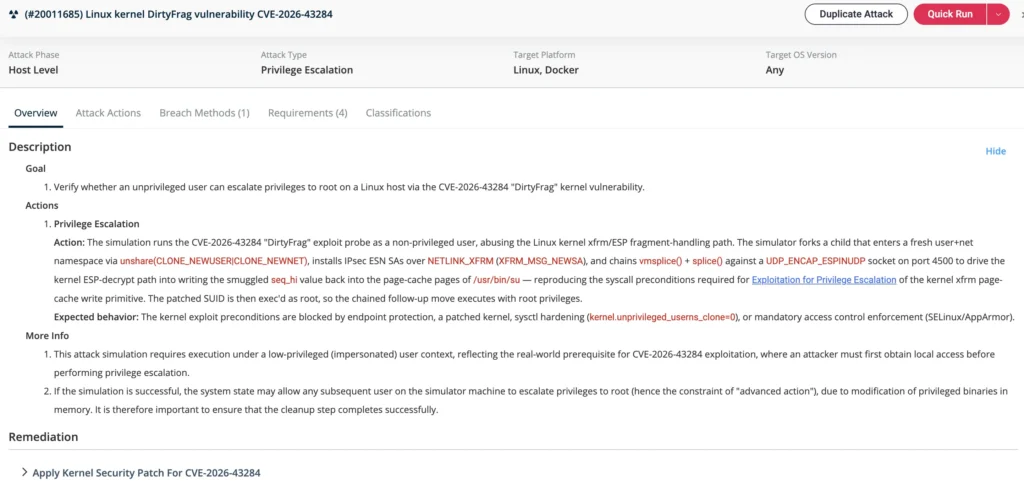
The SafeBreach Labs team has developed simulation content for CVE-2026-43284, now available in the SafeBreach Exposure Validation Platform. Our coverage is designed to safely validate whether your security controls can detect or prevent each stage of the Dirty Frag attack chain.
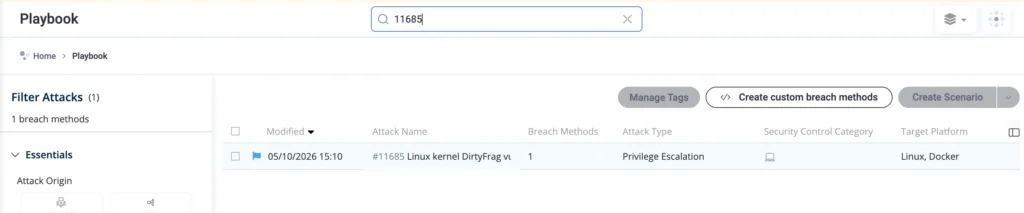
SafeBreach customers can run this simulation in their environment by searching for “11685” and selecting attack “#11685 Linux kernel DirtyFrag vulnerability CVE-2026-43284” from the playbook.
Select the relevant Simulator and run the attack.
The most dangerous vulnerabilities are rarely dangerous in isolation; they become dangerous when chained together. A realistic Dirty Frag attack path might look something like this:
An attacker may gain access through a vulnerable web server, stolen VPN credentials, or a phishing-delivered payload. At this stage, the compromise is often limited to a low-privileged Linux service account, a containerized workload, or an unprivileged user session.
CVE-2026-43284 specifically requires the ability to create an unprivileged user namespace in order to obtain CAP_NET_ADMIN. This is the default on most enterprise distributions, though Ubuntu blocks it via AppArmor.
Many organizations implicitly assume that this limited access reduces overall risk. Dirty Frag directly challenges that assumption by demonstrating how quickly a seemingly contained foothold can escalate into a far more serious compromise.
Using CVE-2026-43284, the attacker corrupts the in-memory page cache of a privileged binary such as /usr/bin/su via in-place AEAD decryption on a spliced page, and escalates to root in seconds. With elevated access, the attacker can disable or tamper with security tooling, dump credentials and secrets, access sensitive application data, modify system binaries, establish persistence, and pivot deeper into the environment. This is the point where a “minor” compromise becomes a full operational incident—and critically, this transition often happens far faster than defenders expect.
Because CVE-2026-43284 is a deterministic logic flaw rather than a race-condition exploit, this escalation step generates none of the crash dumps, retry loops, or kernel panics that traditional LPE detection often relies on: the privilege transition can complete in a single, clean execution.
Once root access is achieved, attackers can manipulate logs, terminate EDR agents, modify kernel-level protections, establish stealth persistence mechanisms, and harvest cloud credentials from local workloads. In hybrid and cloud-native environments, the blast radius can expand rapidly, exposing Kubernetes service account tokens, IAM credentials, CI/CD secrets, and internal API access after successful privilege escalation.
At that point, the original vulnerability is no longer the primary concern—the organization’s ability to detect and contain attacker progression is.
Security teams have spent years improving prevention layers: EDR, multi-factor authentication (MFA), segmentation, vulnerability management, and identity controls.
But Dirty Frag reinforces an uncomfortable reality: Attackers only need one successful foothold.
In practice, many environments still lack confidence around:
This creates a dangerous visibility gap between deploying a security control and knowing with confidence that it can actually stop real attacker behavior. That gap becomes especially problematic during patch windows.
Even mature organizations cannot instantly patch every exposed Linux workload. Operational constraints, uptime requirements, testing dependencies, and legacy systems introduce unavoidable delays. The challenge is determining whether compensating controls are actually effective, whether detections trigger correctly, and whether attackers can still progress despite existing defenses.
This is where continuous security validation becomes critical. Security teams should not wait for active exploitation to answer questions like:
These are validation problems—not just vulnerability management problems. And a CVE score alone cannot answer them.
By continuously emulating real attacker behavior, organizations can measure:
That matters because modern attacks are increasingly defined not by initial access, but by attacker progression after access is obtained.
Dirty Frag also highlights a broader industry issue: many organizations still treat Linux as inherently lower risk than Windows environments.
But today’s infrastructure reality looks very different:
Attackers know this. And as Linux adoption expands, reliable privilege escalation vulnerabilities become disproportionately valuable.
Organizations that validate Windows attack paths—but not Linux attack paths—are operating with incomplete exposure visibility.
To be clear: organizations should absolutely patch Dirty Frag as quickly as operationally possible. But patching alone is not a resilience strategy.
The larger issue is that attackers will continue finding footholds, new privilege escalation flaws will continue emerging, and defenders still need confidence that security controls actually work during the critical window between disclosure and remediation. That confidence cannot come from assumptions alone—it requires continuous validation of how defenses perform against real attacker behavior.
Ultimately, Dirty Frag is more than another Linux kernel vulnerability. It is a reminder that modern security resilience is not defined solely by preventing initial access, but by understanding whether attackers can successfully escalate privileges, evade defenses, and advance through the environment once they are inside.
SafeBreach helps organizations obtain that understanding with confidence. Run the Dirty Frag SafeBreach attack simulation today to ensure your defenses stand ready against this latest threat.Not a SafeBreach customer yet? Learn more about the SafeBreach Exposure Validation Platform then schedule a personalized demo to see it in action.