Blog
An Update on the Heightened Threat of Iranian Cyber Attacks: How to Understand the Risk and Enhance Resilience
Read More
CISA Advisory AA26-097A details an escalating Iranian-affiliated campaign (CyberAv3ngers/IRGC-CEC) exploiting Internet-exposed programmable logic controllers (PLCs) from Rockwell Automation, Schneider Electric, and Siemens across US water, energy, and government infrastructure. This post outlines the attackers’ TTPs—including remote access via Dropbear SSH, project file exfiltration, and HMI/SCADA data manipulation that disables shutdown and alarm logic—mapped to MITRE ATT&CK. It also covers new IOC-based content SafeBreach has added to validate that an organization’s controls detect and block communication with the campaign’s C2 infrastructure, along with mitigation guidance for securing OT environments.
On April 7, 2026, the Federal Bureau of Investigation (FBI), Cybersecurity and Infrastructure Security Agency (CISA), National Security Agency (NSA), Environmental Protection Agency (EPA), Department of Energy (DOE), US Cyber Command – Cyber National Mission Force (CNMF), and Department of the Treasury issued Cybersecurity Advisory (CSA) AA26-097A: Iranian-Affiliated Cyber Actors Exploit Programmable Logic Controllers Across US Critical Infrastructure.
The advisory—significantly expanded in a July 22, 2026 update—provides critical intelligence on ongoing Iranian-affiliated targeting of Internet-connected operational technology (OT) devices, including the tactics, techniques, and procedures (TTPs) and indicators of compromise (IOCs) observed across multiple US critical infrastructure sectors.
The activity has disrupted programmable logic controllers (PLCs) across water and wastewater systems, energy, and government facilities by maliciously interacting with PLC project files and manipulating data on human machine interface (HMI) and supervisory control and data acquisition (SCADA) displays—in some cases disabling critical shutdown and alarm logic and producing both operational disruption and financial loss.
The campaign is attributed to Iranian-affiliated APT actors linked to Iran’s Islamic Revolutionary Guard Corps Cyber Electronic Command (IRGC-CEC), operating under the CyberAv3ngers persona. Across the security industry these actors are also tracked as Shahid Kaveh Group, Hydro Kitten, Storm-0784, BAUXITE, and UNC5691. The authoring agencies assess the activity is consistent with anticipated retaliatory cyber operations tied to heightened US–Iran tensions.
This campaign is the direct successor to the November 2023 CyberAv3ngers operation (AA23-335A), which compromised Unitronics PLCs across US water and wastewater facilities using default credentials. AA26-097A represents a meaningful escalation in both capability and scope:
The underlying weakness being exploited is not a single patchable software vulnerability. It is an architectural one: PLCs deployed to the public Internet without adequate network segmentation, authentication gating, or hardening controls.
The advisory maps the activity to the MITRE ATT&CK Matrix—Enterprise and ICS version 19.
The advisory provides extensive IOCs, including:
Because the threat actors used these addresses within specific historical windows, CISA recommends organizations investigate and vet the listed IP addresses before taking action such as blocking, and query logs for historical targeting. For the authoritative, current list, refer to the full CISA advisory and the associated STIX indicator files on the CISA website.
SafeBreach customers already have access to content that simulates network connections to the threat-group servers associated with this campaign.
These simulations are mapped to MITRE ATT&CK and can be used immediately to validate detection and response capabilities across your infrastructure.
To address the newly released IOC guidance in AA26-097A, we have added two network-reachability simulations that validate whether egress controls detect and block communication with the advisory’s C2 indicators:
These simulations validate detection and blocking of the campaign’s C2 indicators; they do not emulate the PLC exploitation, remote-access-tool deployment, project-file exfiltration, or HMI/SCADA manipulation described above.
Existing SafeBreach customers can now validate their security controls against the advisory’s C2 indicators in multiple ways.
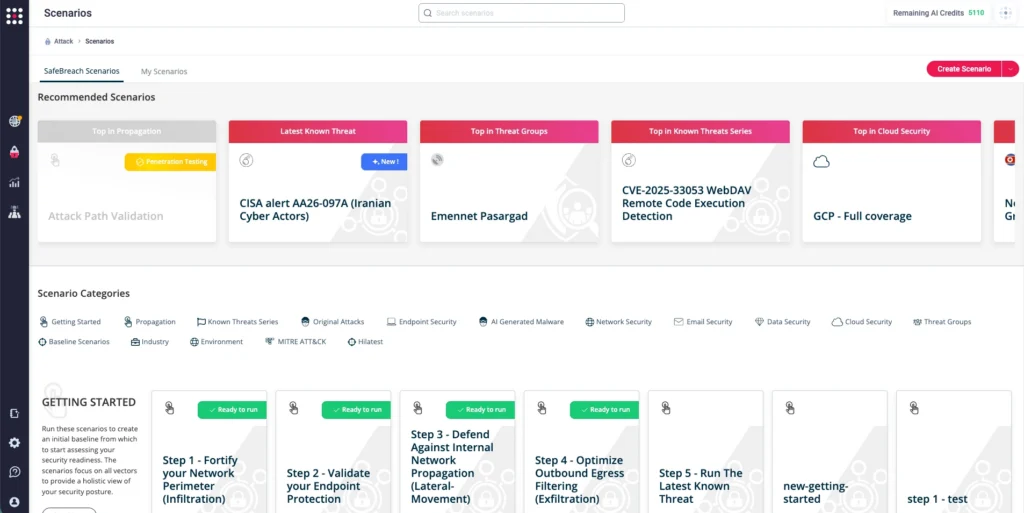
Method 1 — SafeBreach Scenarios: Navigate to the SafeBreach Scenarios page and choose CISA Alert AA26-097A.
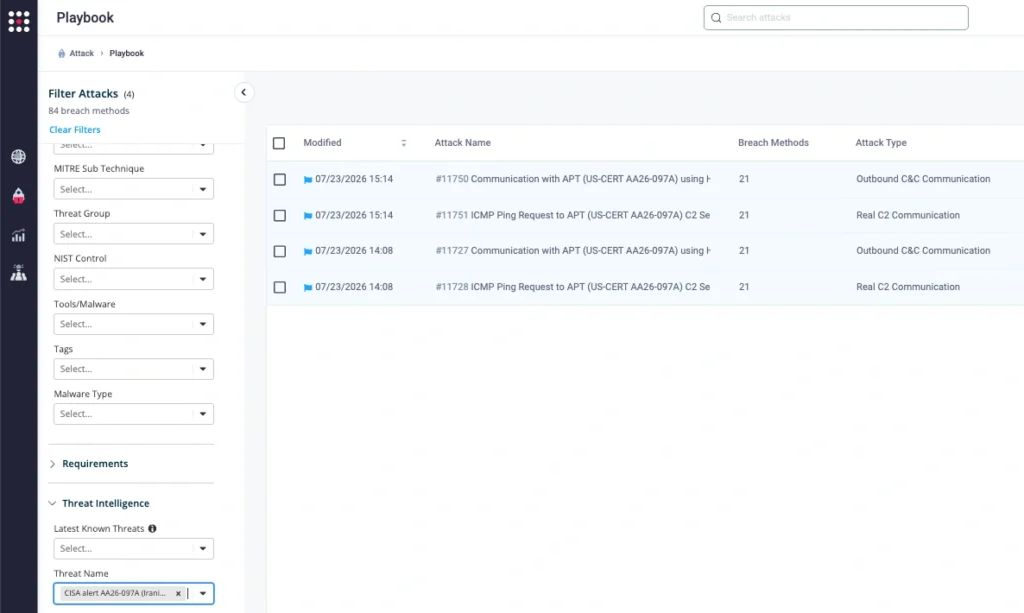
Method 2 — Attack Playbook: Open the Attack Playbook and filter by AA26-097A to view all associated attacks. You can also refer to the list above to confirm which AA26-097A attacks are available.
Method 3 — Known Attack Series Report: Select the AA26-097A report from the Known Attack Series report and click Run Simulations.
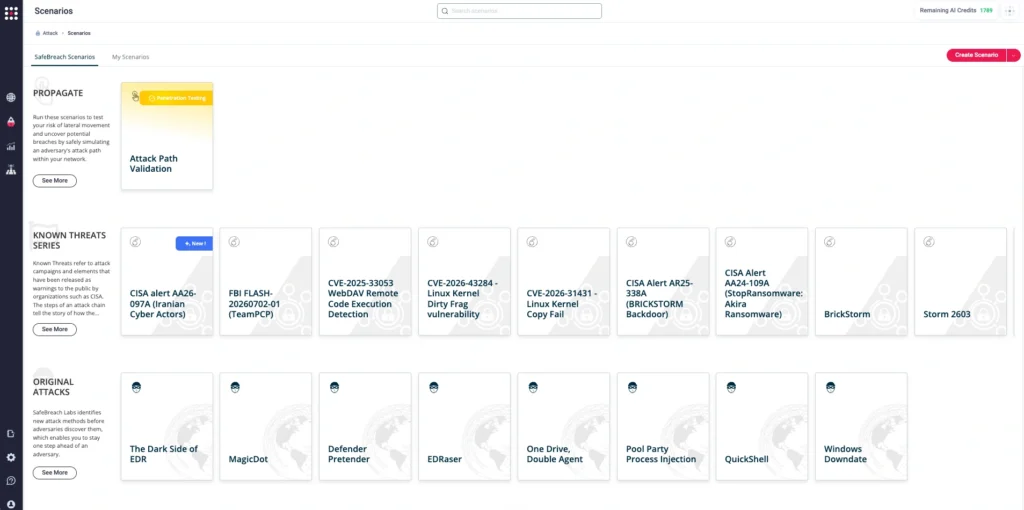
Run the SafeBreach Platform Simulations
Implement Mitigation Strategies (from the CISA advisory)
Refer also to the vendor hardening guidance called out in the advisory: Rockwell Automation Security Advisory SD1771, Schneider Electric’s Modicon controller guidance, and Siemens Security Bulletin 104599.=
Employ Proactive Threat Monitoring
To test your defenses against this campaign’s C2 indicators, sign into SafeBreach and run the latest simulations mapped to AA26-097A. To assess your broader exposure, you can go a step further with SafeBreach Propagate.
Propagate enables you to assess how attackers could pivot across your environment post-compromise—mapping high-risk attack paths, visualizing lateral movement across network zones, and prioritizing remediation based on exposure to your most critical assets. Find out more in the SafeBreach Propagate solution brief.
AA26-097A is a joint cybersecurity advisory issued by the FBI, CISA, NSA, EPA, DOE, US Cyber Command, and the Treasury Department on April 7, 2026 (and significantly expanded on July 22, 2026). It details an Iranian-affiliated campaign exploiting Internet-exposed programmable logic controllers (PLCs) across U.S. water, energy, and government infrastructure.
The campaign initially targeted Rockwell Automation/Allen-Bradley CompactLogix and Micro850 controllers. The July 2026 update expanded confirmed targeting to Schneider Electric (BMX P34/Modicon M340) and Siemens (S7-1200 series), with port-scanning activity suggesting broader, opportunistic interest across other OT vendors.
The activity is attributed to Iranian-affiliated actors linked to IRGC-CEC, operating under the CyberAv3ngers persona (also tracked as Shahid Kaveh Group, Hydro Kitten, Storm-0784, BAUXITE, and UNC5691). They use legitimate PLC configuration software to access misconfigured, Internet-exposed controllers, then exfiltrate project files and manipulate HMI/SCADA displays—in some cases disabling shutdown and alarm logic without alerting operators.
SafeBreach customers can validate their defenses through the SafeBreach Scenarios page (filtered by AA26-097A), the Attack Playbook, or the Known Attack Series report, all of which provide IOC-based content to validate that their controls detect and block communication with the campaign’s C2 infrastructure.