Solution Brief
SafeBreach CTEM Platform
Read More
AI hasn’t created new security problems—it has dramatically amplified existing ones, collapsing the time between vulnerability disclosure and active exploitation from days to hours. Despite widespread adoption of the Gartner™ Continuous Threat Exposure Management (CTEM) framework, most programs still fail to operationalize it. The challenge is not about tooling, but rather about a lack of coordination: no single system connects signals across an enterprise’s ever-growing security stack, correlates and validates the findings, and turns them into prioritized action that measurably reduces risk and enhances cyber resilience. The SafeBreach CTEM Platform—powered by the SafeBreach Helm AI infrastructure layer—was built to solve that challenge. SafeBreach Helm orchestrates three purpose-built AI agents to operationalize the entire CTEM lifecycle, transforming disconnected security tools into a complete closed-loop CTEM solution. Powered by a decade of enterprise experience, real-world attack data, and validated outcomes, SafeBreach Helm ensures risk management is continuous, validated, and autonomous.
Something has shifted in the threat landscape—not gradually, but sharply. Adversaries now operate at machine speed, and the gap between when a vulnerability is disclosed and when it’s weaponized has shrunk from days or weeks to just hours. The adversary has gotten much, much faster, and AI-generated attack tooling has made this not only possible, but shockingly scalable. Most security programs are challenged to match pace.
And the resulting numbers are unforgiving: approximately three out of four breaches exploit known, unpatched vulnerabilities, while the median dwell time for attackers inside enterprise environments remains around 200 days.

This is the new operating environment for every CISO and patching your way out is no longer an option—the velocity of new exposures will always outpace a manual remediation pipeline. An effective approach requires a different set of principles: assume breach, maximize the controls you’ve already invested in, and proactively find your weaknesses before attackers do.
While this sounds simple, many organizations struggle to execute on these in practice based on a similar problem most security leaders know intimately: tool sprawl.
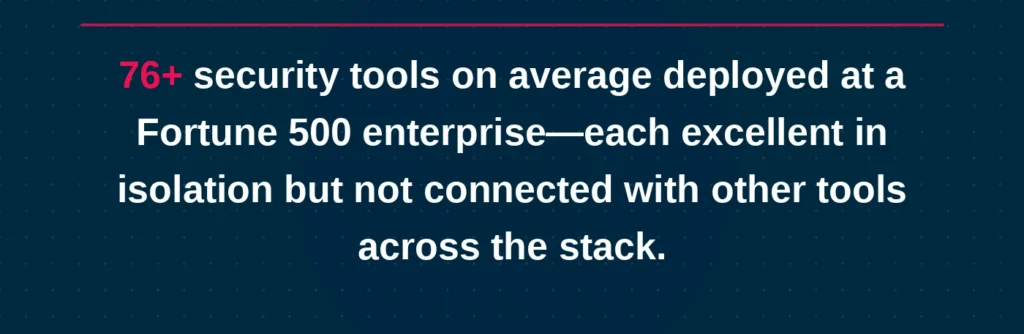
The average Fortune 500 security team operates more than 75 tools—and procurement is usually working on approval for another one at any given point in time. Vulnerability management, threat intelligence, penetration testing, BAS, EASM, asset management, EDR, SIEM, IAM, CNAPP, GRC, SOAR, CSPM—each one was purchased to solve a real problem, and each one does its job in isolation. But none of them speak to each other.
All those sensors generate enormous amounts of data, but no single system aggregates the signals, correlates and validates the findings, and turns them into prioritized action that measurably reduces risk and enhances cyber resilience. As a result, security teams end up with fourteen inputs with zero coherent output. The data exists, but the insight does not.
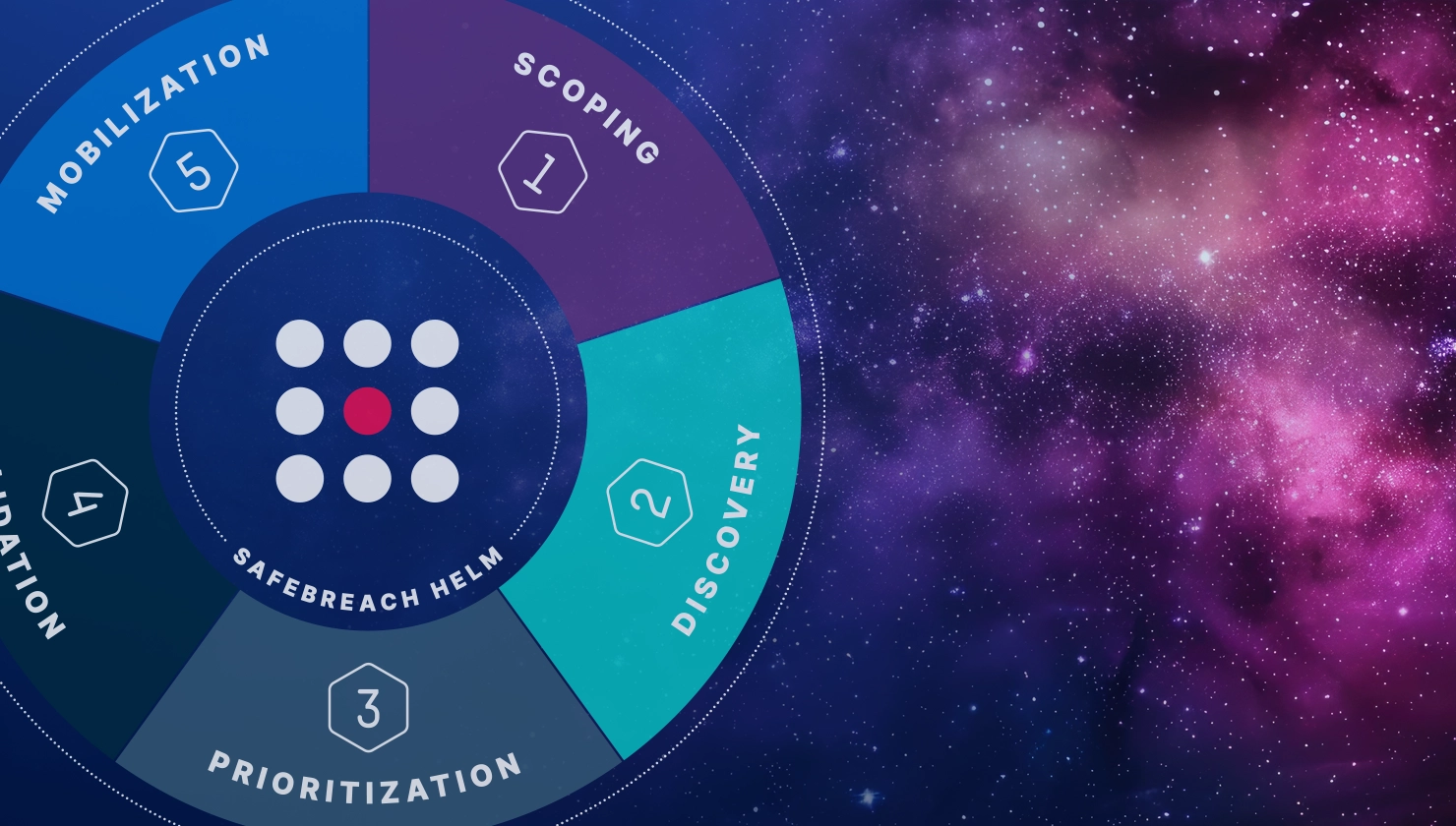
The security industry’s answer to this challenge has been Continuous Threat Exposure Management (CTEM). The framework is built around five phases—Scoping, Discovery, Prioritization, Validation, and Mobilization—designed to help organizations proactively and continuously identify, evaluate, and mitigate threats.
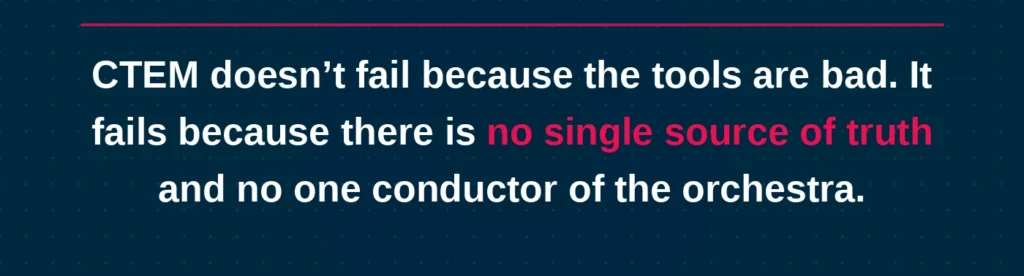
CTEM is on the radar of most CISOs, and the logic of the theoretical framework is sound. But operationalizing it within the large, complex IT environments of enterprise organizations has proven to be wildly challenging—not because the tools are bad, but because of the complex and manual coordination that’s needed to stitch together all of the tools, processes, teams, and workflows that are involved.
Discovery sits in one team. Validation lives in another. Prioritization and mobilization operate on different timelines with different definitions of what “done” actually means. There’s no shared understanding of real risk, no continuous feedback loop closing the system, and no single source of truth for what’s actually exploitable right now. Decisions get made without evidence, and the program becomes another quarterly report rather than a live security function.
For years, the industry’s instinct has been to solve the coordination problem with another integration platform, another dashboard, another data lake. The SafeBreach CTEM Platform takes a different approach. Rather than simply adding another tool to the stack, the SafeBreach CTEM Platform utilizes SafeBreach Helm—the platform’s powerful AI infrastructure layer designed to navigate the complexities of modern security architectures to implement CTEM at enterprise scale. It does this by orchestrating three purpose-built AI agents that utilize the technology stack you already have in place to operationalize each phase of the CTEM lifecycle—continuously and autonomously.
Through a single natural-language interface, SafeBreach Helm coordinates three purpose-built AI agents—the Analyst Agent, Validation Agent, and SecOps Agent—to continuously discover, validate, and remediate exposures based on real attacker behavior.
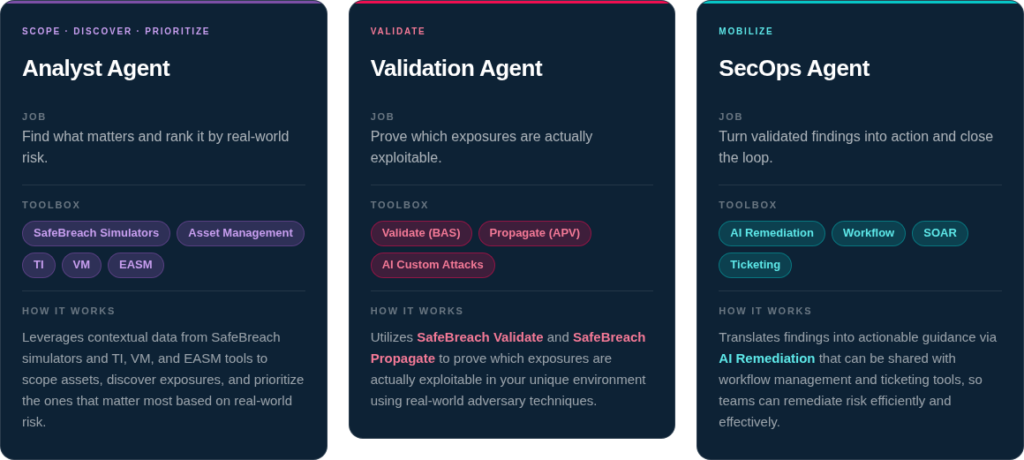
Teams can ask SafeBreach Helm one question and get one actionable answer in return. For example: “Where could Volt Typhoon threat actors gain traction in my environment, and what gaps should I fix first?” In response, Helm automatically coordinates:
The result is a security operation where a fresh threat intelligence indicator can be validated against your controls and generate a tuned configuration change that is pushed back into your environment—all in a single, continuous flow, in minutes rather than months.
Any vendor can wrap an LLM around a security workflow. What separates SafeBreach Helm is the foundation it is built on. The LLM is the easy part. The hard part—the credibility—comes from three things SafeBreach has spent a decade building:
The shift the SafeBreach CTEM Platform and SafeBreach Helm makes possible is a fundamental one: risk management stops being a quarterly deliverable and becomes a live system. Security programs that utilize these technologies aren’t periodically assessing their posture—they’re continuously validating it, automatically prioritizing action, and closing the loop at a pace that matches the speed at which attackers are operating.
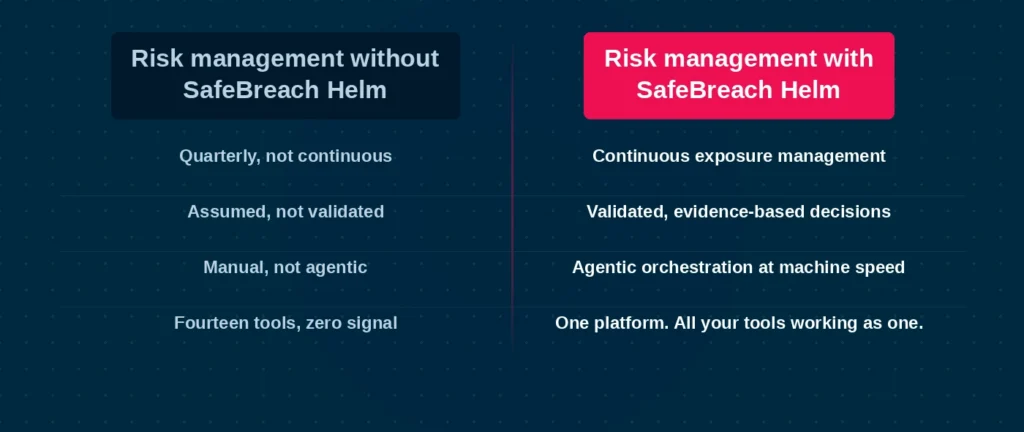
Continuous, not quarterly. Validated, not assumed. Agentic, not manual. One unified platform, not fourteen different signals. This type of of operationalized CTEM program isn’t aspirational—it is available with the SafeBreach CTEM Platform and SafeBreach Helm today. Request a customized demo to see it for yourself.