PodcastVideos
Podcast: The Russian Cyber Triad: GRU, SVR, FSB Explained
Listen Now
CISA Advisory AA26-204A details a Russian state-supported phishing campaign, active since July 2025, in which the advanced persistent threat (APT) group LAUNDRY BEAR (also tracked as Void Blizzard, CL-STA-1114, and TA488) targets the Zimbra Collaboration Suite (ZCS) across US and allied government and commercial networks. Using a custom-developed capability named “Ulej,” the actors leverage a view-based exploit that triggers automatically when a user simply opens a malicious email in an unpatched ZCS webmail instance—originally a zero-day, now tracked as CVE-2025-66376. The exploit exfiltrates the organization’s email directory, the last 90 days of the victim’s communications, and other sensitive data to actor-controlled servers. This post outlines the campaign’s TTPs—mapped to MITRE ATT&CK—summarizes the advisory’s IOCs, and covers the IOC-based content SafeBreach is adding to validate that an organization’s controls detect and block communication with the campaign’s exfiltration infrastructure, along with mitigation guidance for securing ZCS environments.
On July 23, 2026, the National Security Agency (NSA), together with the Federal Bureau of Investigation (FBI), the Netherlands Defence Intelligence and Security Service (MIVD), the Netherlands General Intelligence and Security Service (AIVD), the Cybersecurity and Infrastructure Security Agency (CISA), and more than 20 additional US and allied partner agencies, issued joint Cybersecurity Advisory (CSA) AA26-204A: Russian State-Supported Cyber Actors Conduct Phishing Campaign Targeting Users of Zimbra Collaboration Suite. This advisory provides critical intelligence on an ongoing Russian state-supported phishing campaign, including the tactics, techniques, and procedures (TTPs) and indicators of compromise (IOCs) observed as the actors steal email and sensitive data from targeted organizations.
Since July 2025, the threat group tracked as LAUNDRY BEAR has used phishing emails to target the Zimbra Collaboration Suite (ZCS) across US and allied government and commercial networks—leveraging a view-based exploit that triggers automatically when a recipient simply opens a malicious message in an unpatched webmail instance.
LAUNDRY BEAR is a Russian state-supported advanced persistent threat (APT) group first publicly detailed in May 2025, when the Netherlands’ AIVD and MIVD and Microsoft independently highlighted the actor—Microsoft tracking it as Void Blizzard. Across the security industry the group is also tracked as CL-STA-1114 and TA488 (formerly UNK_PitStop).
Unlike financially motivated ransomware crews, LAUNDRY BEAR’s objective is espionage: bulk collection of email and organizational data from government and commercial targets aligned with Russian state intelligence interests. The campaign has been active since July 2025 and continues today against organizations that have not patched their Zimbra webmail.
What makes this campaign notable is its low interaction requirement. Using a custom capability the actors call “Ulej,” LAUNDRY BEAR sends phishing emails carrying a view-based exploit for CVE-2025-66376—a vulnerability in the ZCS webmail interface that executes automatically the moment a victim opens the email. No link needs to be clicked and no attachment needs to be opened. Once triggered, the exploit exfiltrates the organization’s email directory, the previous 90 days of the victim’s communications, and other sensitive information to servers controlled by the actors. The flaw was a zero-day when the campaign began and remains effective against any ZCS instance that has not applied the vendor’s fix.
The advisory maps LAUNDRY BEAR’s activity across the full ATT&CK chain (MITRE ATT&CK for Enterprise v19). The techniques below are grouped by tactic; Appendix A of the advisory provides the complete correlation, and Appendix B maps the corresponding MITRE D3FEND countermeasures.
The advisory publishes an extensive, historically attributed IOC set. The authoring agencies caution that LAUNDRY BEAR rotates infrastructure frequently—individual IPs, domains, and compromised sender addresses may already be stale—so verify current activity before acting on any single indicator. The indicators fall into several categories:
Useful hunting aids: exfiltration is triggered through image requests to d-{id}…i.{domain}/pixel.gif (DNS) and js-{id}.i.{domain}/v/p or /v/d (HTTPS), and the actors’ Nginx reverse proxy only forwards traffic whose TLS SNI matches “*.i.*.”
For the full, machine-readable set, download the AA26-204A STIX XML and STIX JSON bundles from the CISA advisory page.
In total, four simulations are mapped to AA26-204A: 110 and 903 (existing exfiltration-behavior coverage) and 11752 and 11753 (new IOC-based reachability coverage). Every method below runs from this same set.
SafeBreach already simulates the exfiltration-over-alternative-protocol behavior (T1048) at the core of this campaign- data theft over both HTTPS and DNS, the two channels LAUNDRY BEAR uses to move stolen mailboxes and directories to its Flowerbed infrastructure:
These simulations are mapped to MITRE ATT&CK and can be run immediately to validate that your DLP and egress controls detect and block the exfiltration techniques this campaign relies on.
To address the IOC guidance in AA26-204A, we are adding network-reachability simulations that validate whether your egress controls detect and block communication with the advisory’s exfiltration infrastructure.
These simulations validate detection and blocking of communication with the campaign’s actor-controlled C2 indicators.
Together, these four simulations are the complete SafeBreach content mapped to AA26-204A: 110 and 903 validate the exfiltration behavior (HTTPS/DNS), and 11752 and 11753 validate reachability to the campaign’s C2 indicators. Run them from any of the methods below.
SafeBreach customers can now validate their security controls against the campaign’s C2 and exfiltration indicators in multiple ways.
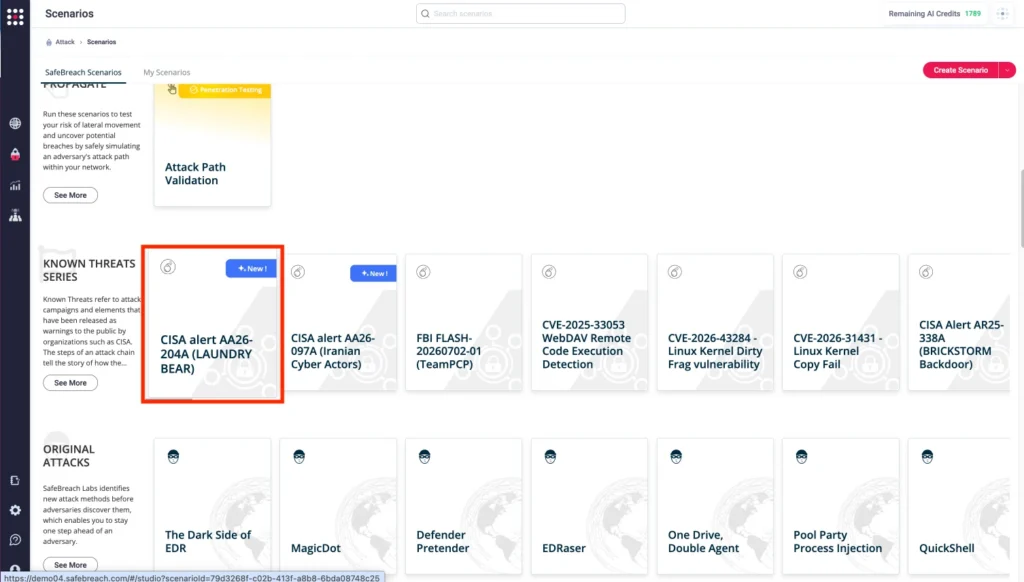
Method 1 — SafeBreach Scenarios: Navigate to the SafeBreach Scenarios page and choose CISA Alert AA26-204A.
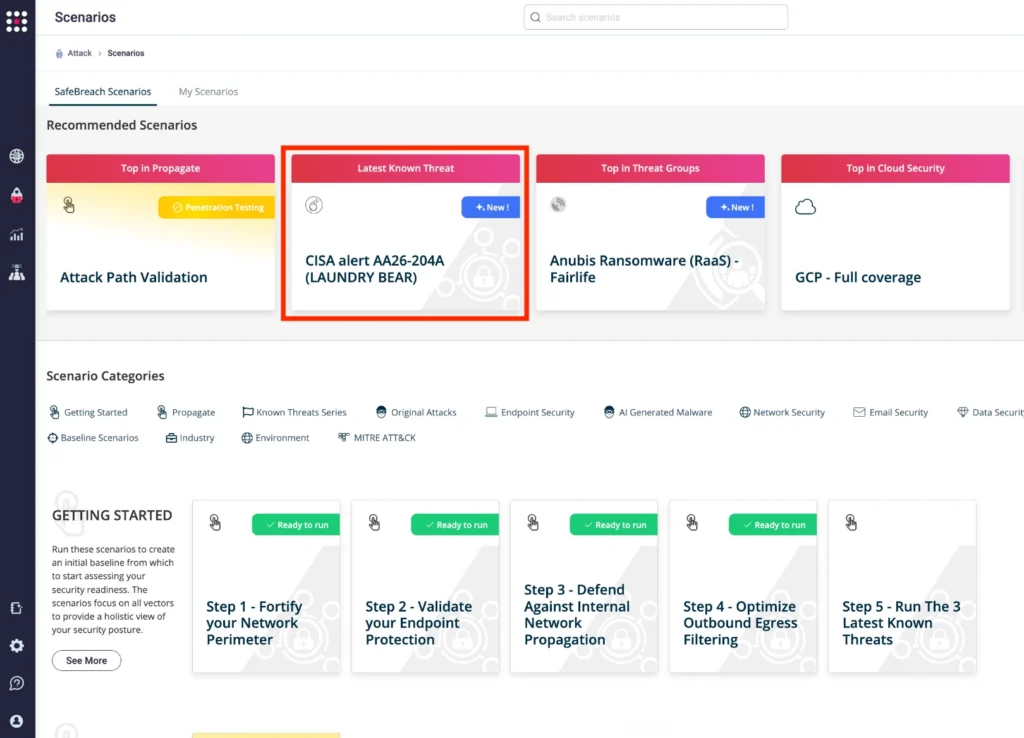
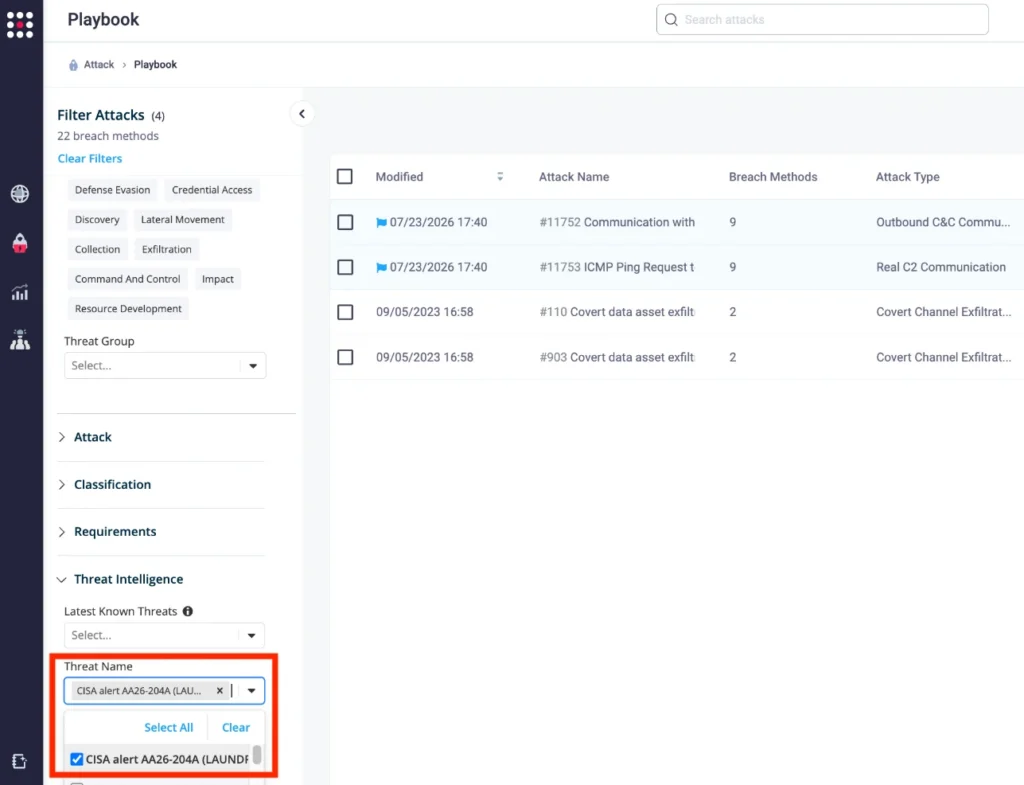
Method 2 — Attack Playbook: Open the Attack Playbook and filter by AA26-204A to view all associated attacks. You can also refer to the list above to confirm which AA26-204A attacks are available.
Method 3 — Known Attack Series Report: Select the AA26-204A report from the Known Attack Series report and click Run Simulations.
Run the SafeBreach Simulations
Implement Mitigation Strategies
Employ Proactive Threat Monitoring
For a complete view of your security gaps against the LAUNDRY BEAR campaign, sign into SafeBreach and run the latest simulations mapped to AA26-204A. Because this campaign is built on stolen mailboxes, directories, and credentials—the raw material attackers use to move deeper into an environment—you can go a step further with SafeBreach Propagate.
Propagate enables you to assess how attackers could pivot across your environment post-compromise—mapping high-risk attack paths, visualizing lateral movement across network zones, and prioritizing remediation based on exposure to your most critical assets. Find out more in the SafeBreach Propagate solution brief.
AA26-204A is a joint cybersecurity advisory led by the National Security Agency (NSA), with co-sealing partners including the FBI, the Netherlands’ MIVD and AIVD, CISA, and more than 20 additional cyber and intelligence agencies across allied nations. Published in July 2026, it details a Russian state-supported phishing campaign—ongoing since July 2025—that targets the Zimbra Collaboration Suite (ZCS) to steal email and sensitive data from U.S. and allied government and commercial networks.
The campaign targets the Zimbra Collaboration Suite (ZCS) webmail service. The actors exploit CVE-2025-66376, a view-based vulnerability that executes automatically when a victim opens a specially crafted email in a vulnerable version of ZCS—no clicks or attachments required. It was used as a zero-day when the campaign began and continues to succeed against ZCS instances that remain unpatched. Organizations still running unpatched Zimbra webmail are at greatest risk.
The activity is attributed to LAUNDRY BEAR, a Russian state-supported APT group also tracked across the security industry as Void Blizzard, CL-STA-1114, and TA488 (formerly UNK_PitStop). Using a custom capability named “Ulej,” the actors deliver phishing emails that trigger the ZCS view-based exploit on open, then exfiltrate the victim organization’s email directory, the last 90 days of communications, and other sensitive information to servers they control.
SafeBreach customers can validate their defenses through the SafeBreach Scenarios page (filtered by AA26-204A), the Attack Playbook, or the Known Attack Series report, all of which provide IOC-based content to validate that their controls detect and block communication with the campaign’s C2 and exfiltration indicators.